Physics of the World
Four rules everything else follows from: time always runs, light is the ceiling, resources stay at home and knowledge stays in the head of a copy.
In short
System K15 is a slow space game about a digitised human who woke up as a file aboard an alien probe and now settles the galaxy with copies of themselves. The physics here is close to the real thing: nothing outruns light under its own power, no cargo travels between stars, and distance honestly costs time. A world where distance means something is all the game needs.
Below are four rules. The other sections explain what follows from them.
Time always runs
One real minute is one game day. Six hours make a game year; a week comes to almost three decades.
The clock runs with the tab closed. Construction, flights and research carry on while you work, sleep or live your life. Come back after a day and the world has lived four years and written you a report.
Missing a day costs nothing: there are no daily rewards, streaks or expiring timers.

Light is the ceiling
A signal covers one light year in one game year, which is six real hours, and nothing can overtake it. News takes a day or more to reach the next star. Letters to a neighbour move at the pace of an eighteenth-century mail coach, minus the horses.
Hence the main thing: everything you know about a distant colony is its past. An order will find it changed, so from afar you set goals and leave the details to whoever is there.

Resources stay at home
Matter never crosses the boundary of a star system. There is no trade, no market, no freighters and no logistics: a shipyard is built from metal mined in the same system.
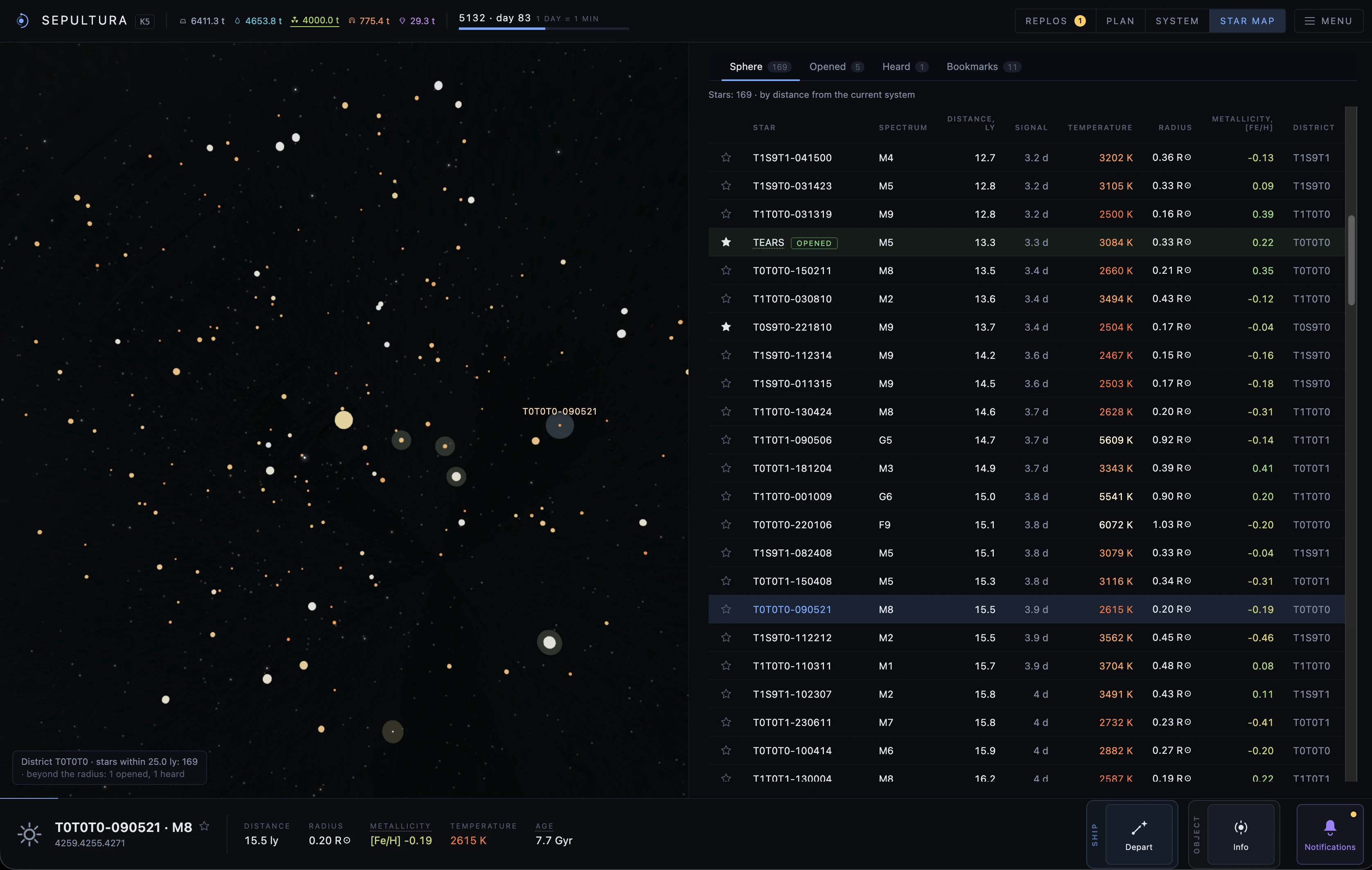
That makes "where to fly" the main decision of the game. A poor system cannot be propped up by a rich one, so a colony's site is chosen once. A good system is a full set of zones: an asteroid belt, a gas giant, ice on the outskirts. That set is worth more than one spectacular world.
Knowledge stays in the head
A technology tree belongs to the copy that grew it. A new copy is born with what the original knew, and from that moment the two diverge for good. Copies cannot retell each other what they have learned — not when they meet, not over comms, not through you.
That is how your three copies become three different characters over time. The details are in "Research and Knowledge".
One exception
A tick is the only thing in the game that acts at once and everywhere: it takes one game day off one running timer. It does not speed up communication, it does not make a flight faster than light, and it carries no matter across a system's boundary. Part of every timer cannot be bought off with any number of ticks — that part you wait out. More in "Time and Sessions".
What the world does not have
Faster-than-light drives, interstellar trade, a market or diplomacy. Combat between players: another player's ship is never a target, and that is a rule of the game. Pirates and sieges: nobody will come to destroy your colony.
Combat does exist — with the aliens, and only where you went yourself. See "Threats and Losses". And another player may breach an empty colony for a while — without breaking anything; see "Scripts and the Firewall".