Probe Flight
From orbit a planet or a belt is seen only skin-deep. The rest is earned by hand: you steer a probe over the terrain or between the rocks of a belt from zone to zone, and this is the only place in the game where the count is in seconds.
What the probe is for
A station over unsurveyed ground takes only what lies on top, and the more is known about the interior, the more tonnes it lifts. From orbit a scanner sees only a small share of a planet, a moon or a belt sector, and a better instrument raises that share only a little. Only the outer orbit it reads in full: there is no ground there and nothing to fly over.
Everything else is surveyed by a probe flight. A short visit is not penalised: the colony digs without it, by what can be seen from above. The flight gives a long evening more survey and more tonnes.
What it looks like
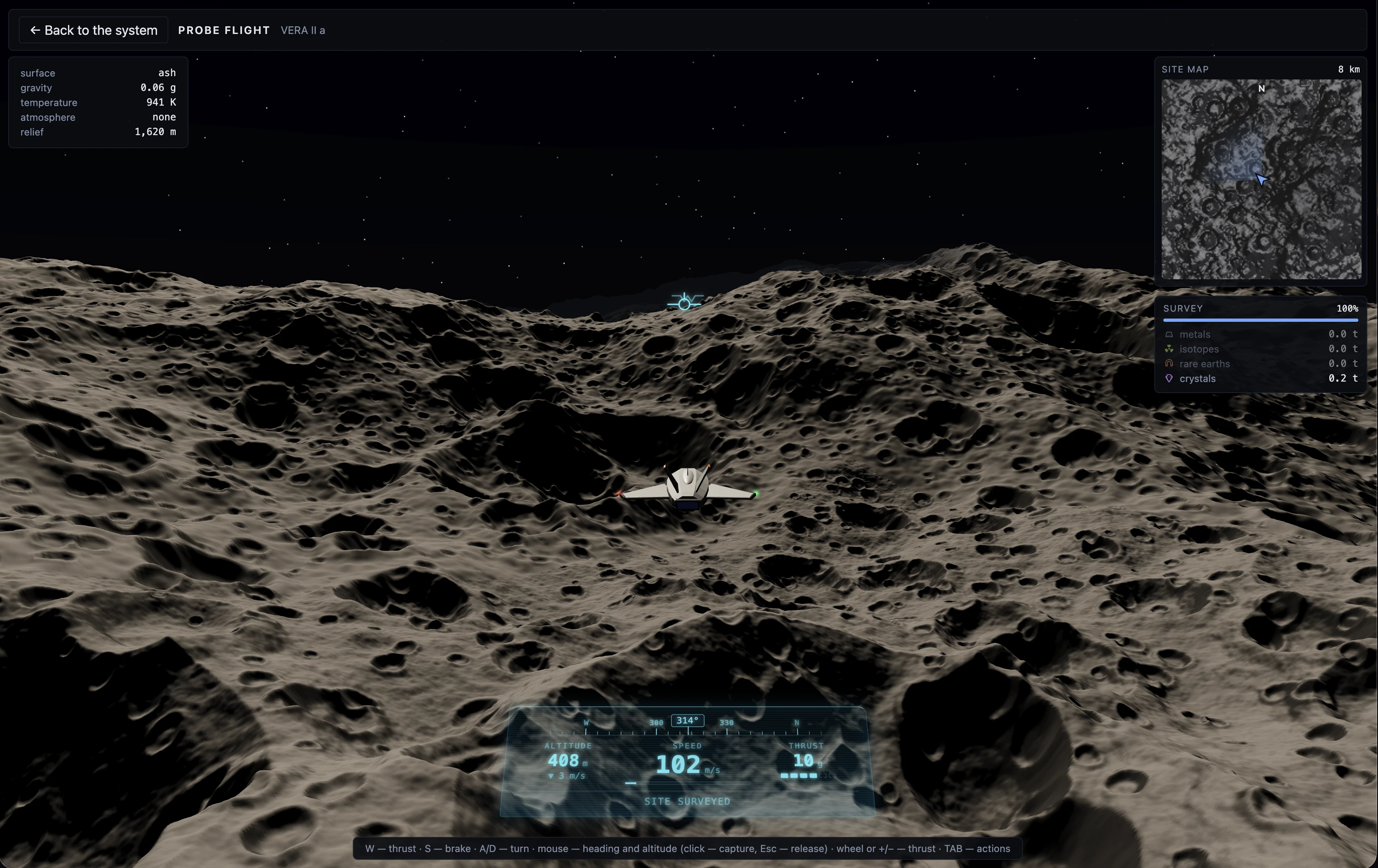
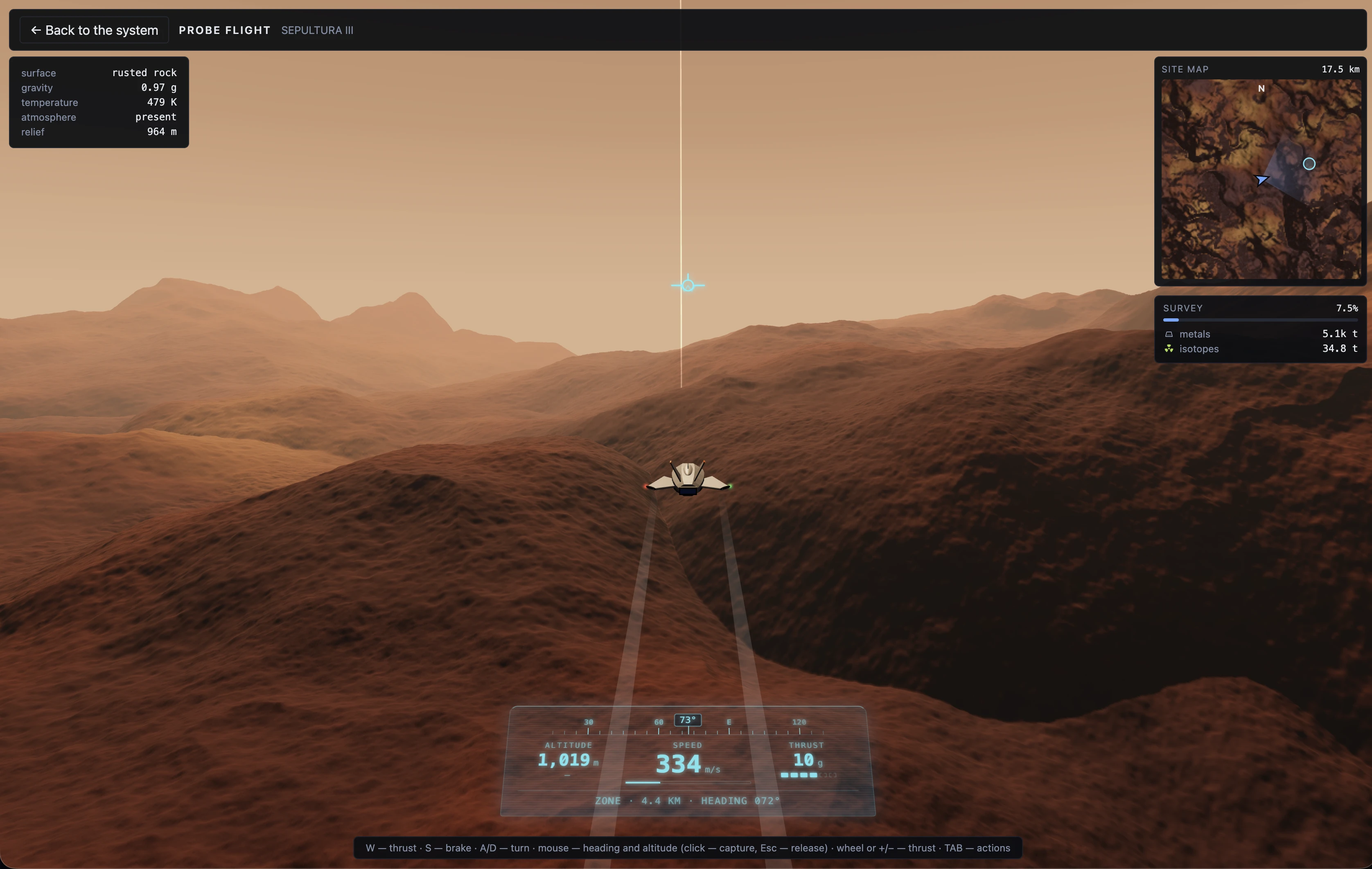
The system map gives way to a view from behind the probe: below you is the terrain of this body, built from its own data. Sharp craters on an airless world, smoothed hills and valleys where there is an atmosphere, cracks and pressure ridges on an icy one. From a moon you see its planet in the sky, at its true size and in its true phase.
Over a gas giant there is no ground at all. The probe flies among towers of cloud, and the thickening haze won't let it below the pressure limit.
A belt has neither ground nor up and down. The probe flies between bodies, usually tens of kilometres from one to the next. The asteroid belt is elongated, cratered boulders of stone. The Kuiper belt is the same irregular boulders, only dark grey and covered all over in small craters, and the sun there barely shines.
Controls
The flight runs on thrust and inertia. W is thrust, S is the brake, A and D turn; the mouse sets heading and altitude, the wheel the thrust step. The higher thrust steps are opened by research.
The probe holds its altitude by itself and holds on to the speed it has gained just as stubbornly. In an atmosphere the air slows it; in a vacuum nothing does: a probe sped up over an airless moon will keep flying until you stop it. And every world has its own air: in a thick sky the probe flies slower and gets less far on a tank; in a thin one it picks up speed easily, but skids through the turns.
Over a world whose air nobody has measured yet, the probe runs an analysis on the way: the first minute of flight is the measurement, and its bar runs on the "Atmosphere" panel. What follows from it for a person is in "Air and People".
Zones
A zone is marked on the ground — a circle with a beam standing over it. In a belt the zone is the body itself: the beam comes down onto it from above, and the scan runs while the probe keeps close to its surface. Fly in and the scan starts by itself, the beam turns green; fly out and the scan pauses until you return. Each new zone is farther than the last, and each one adds a few percent to the survey.
How much a zone gives depends on where the probe came from. From a ship with a scanner the survey can be taken all the way, and the better the scanner, the faster. With the starting one, a full survey of a planet is an evening, and not just one: patience stands in for the instrument, only slowly.
Your own factory or mining station over a body or in a belt sector can send a probe too, and no ship is needed for it. A station can take the survey up to the ceiling of its level. That way a colony whose copy has left does not go blind.
Sometimes the probe hears something down there worth bringing aboard.
What can break
Hit the ground or a boulder too fast and the probe is wrecked, and the scan under way is lost. The next probe takes a few minutes to prepare — a ship has its own, a station its own — and research shortens the wait. Everything recorded earlier stays recorded.
What is surveyed is a fact of the world
What is surveyed is surveyed for everyone who arrives next. The next zone stands in the same place for anyone and waits between flights. What is mined does not come back: surveying raises the ceiling of the deposit, but what the stations have taken out is gone for good.